

Ghyll Royd School was founded in November 1889 by Augustus Wooldridge Godby, with a vision “to prepare the sons of gentlemen for entrance to the Royal Navy and public schools.” Mr Godby, a Classics graduate from Cambridge University, left Dewsbury Grammar School in 1889 to open his own school in Ilkley.
The original Ghyll Royd School was situated in a rented house with 30 acres of land around Grove Road near Hebers Ghyll (now Hollingwood Rise). After 14 years, Mr Godby purchased the property and remained Headmaster for an impressive 33 years until his death in 1922, tragically after catching a chill during the school’s Bonfire Night celebrations.
The Early Years
In the early 1900s, the school focused on traditional pursuits, with activities such as hunting, rifle drills, shooting, and boxing. At that time, the surrounding landscape between Panorama Wood and Skipton Road was open pasture known as Ewe Croft.
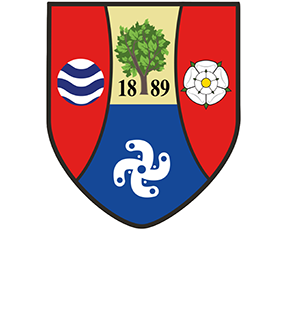
The school crest has evolved over time. Initially a white-on-black GR monogram, it later became a more detailed design: the wavy circle represents the water of a “Ghyll,” and “Royd” refers to a clearing — symbolised by a solitary tree, the Tree of Knowledge. The crest also incorporates the Swastika symbol from the ancient Swastika Stone on Ilkley Moor, the White Rose of Yorkshire, and the school’s founding date. This design remains a central part of the school’s identity.
1923–1929: The Jukes Era
Following Mr Godby’s passing, the school was bought by Mr and Mrs M.N. Jukes. Mr Jukes, an Oxford graduate, served as Headmaster from 1923 to 1929, during which time he introduced a new fee structure with ‘optional extras’ and saw the construction of the pavilion on the sports grounds at Stourton Road. Termly fees ranged from 6 to 10 guineas, with enrolment remaining around 50 pupils.
1929–1966: The Frost Years
In 1929, the school was sold to Mr A.W.T. Hammerton and Mr G.R. Frost. Mr Hammerton retired in 1933, leaving Mr Geoffrey Ryan Frost in sole charge. A Cambridge man skilled in languages and mathematics, Mr Frost brought along fellow Cambridge scholar Mr Rankin. He introduced amateur dramatics, built a swimming pool, and founded the Old Boys’ Association. Mr Frost was a forward-thinking Headmaster, often funding the school through sponsorships and creative means, including named chairs and trophies, many of which still exist today.
The outbreak of World War II in 1939 led to a sharp rise in student numbers, particularly boarders, with pupils increasing from 50 in July to 72 by September. Girls were also admitted during this time. By the time Mr Frost retired in 1966, after 37 years of service, pupil numbers had doubled to 100.
1966–1979: Mr D. Newman
Mr D. Newman took over in 1966, arriving from Clevedon in Somerset. He led the school through a time of significant change in independent education. Boarding declined, and the age of entry fell from 5 to 4, while transfer to grammar schools shifted from age 14 to 11. Mr Newman also rebuilt the sports pavilion after a fire, created the Ghyll Royd School Association, and introduced a science lab and gym. A committed Christian, Mr Newman left in 1979 to become a Baptist minister in Lancashire.
1980–1984: Dr Moorhouse and Mr Carter’s Farewell
Dr Moorhouse, a talented musician and pianist, served as Head from 1980 to 1984. During this time, Mr Christopher Carter, who had joined the school in 1940, retired after 45 years of service. Sadly, he died two years later in a car accident.
1984–1998: Mrs Eileen Shepherd
In 1984, Mrs Eileen Shepherd, a long-serving staff member, became Head Teacher. Her leadership focused on increasing pupil numbers, achieving 117 pupils in time for the school’s centenary in 1989 — the highest enrolment in the school’s history at the time. As she approached retirement, Mrs Shepherd planned to close the school. However, a Charitable Trust was formed to secure the school’s future — a foundation that remains in place today.
1998–2003: Mrs Jennifer Bonner
Mrs Jennifer Bonner became Head Teacher in August 1998. She oversaw one of the most significant moments in the school’s history: the move from Grove Road in Ilkley to Greystone Manor in Burley-in-Wharfedale. This move, completed in May 1999, gave Ghyll Royd a beautiful new home in a restored Victorian manor with extensive grounds. Mrs Bonner retired in December 2003, fondly recalling her time at the school as “wonderful.”
2004–2011: Irene Connor
Mrs Irene Connor became Head Teacher in January 2004, bringing international experience from her time as Head of an International Infant School in Cairo. She enhanced the school’s creative curriculum, introduced the ICT Suite, and developed the school hall into a multi-purpose space. Her farewell speech in December 2011 highlighted the school’s nurturing ethos:
“The individual time and genuine care and concern that the children enjoy at the school nurture, stimulate and motivate learning. The school ethos and culture give the children the confidence to face new challenges in an ever-changing and demanding society.”
2012–Present: A Modern Chapter of Excellence
In January 2012, Ghyll Royd School entered a new phase of development and ambition, building on its rich heritage with a strong commitment to innovation and excellence. Under the leadership of the current Head Teacher, the school has grown both in reputation and provision, earning an ‘Excellent’ rating in all areas from the Independent Schools Inspectorate in October 2022, the highest possible judgement under the new framework and equivalent to Ofsted’s ‘Outstanding’.
Throughout this time, Ghyll Royd has:
- Extended its Creative Arts and Music programmes, gaining national recognition for nurturing talent and performance.
- Introduced a wide range of extracurricular activities, from STEM clubs to Forest School, supporting holistic development.
- Embedded the values of Care, Courtesy, Concentration, Challenge, Consideration, and Co-operation in daily life — creating a compassionate and high-achieving school community.
- Invested in facilities and digital learning, including interactive technologies, specialist teaching areas, and enhancements to the Pre-School and outdoor learning environments.
- Strengthened relationships with parents and the wider community, regularly celebrating learning and success through performances, exhibitions, and events.
Today, Ghyll Royd School continues to flourish, blending traditional values with modern educational practices. Our pupils leave us confident, articulate, and ready to meet the challenges of the future.